Trisomy 13 (also known as Patau syndrome) is a congenital chromosomal disorder caused by the presence of an extra 13th chromosome, resulting in three copies instead of the usual two.
Affecting approximately 1 in 5,000 to 12,000 live births, it is characterized by severe intellectual disabilities and serious complications throughout the body, including the brain, heart, and facial structures.
In the past, the survival rate within the first month of life was around 20%, and less than 10% of children survived to their first birthday. Yet, this boy is now 17 years old, attends school, and can eat meals by mouth. This is a miraculous story filled with love and gratitude between a mother and her son.
Overcoming Despair Through the Power of Water
Interviewer: Raising your child must have been a very long journey. The shock of finding out he had a severe illness right after birth must have been immense. How did you manage to get through it?
Takeno: When my son was born and diagnosed with Trisomy 13 (Patau syndrome), I had no idea what it even meant. Our parenting journey began in absolute despair, knowing something was profoundly wrong without understanding the specifics.
The doctor told me, “Children with this condition have never been known to survive. It wouldn’t be wrong to turn off the ventilator here and let his life end. You have your own life to live too.”
Those words shocked me to my core. I had believed he was living by God’s grace, but I was being told that his life was sustained by electricity. The despair of knowing his life could end the moment a switch was flipped was overwhelming. I refused to turn off the ventilator, but feeling abandoned by both the medical world and God, everything went dark before my eyes. I didn’t know what to do.
However, a saving grace arrived: I happened to be reading Dr. Masaru Emoto’s book, The Hidden Messages in Water. When I pumped breast milk to deliver to the hospital for my son, I would play beautiful music for it and freeze it before bringing it in. I poured my prayers into it, wishing that all the water inside my son’s body would transform into beautiful crystals when he drank it.
Looking back, I wonder what would have happened if I hadn’t encountered Dr. Emoto’s book back then.
I began to think about sending that same wish throughout his entire body. I believed that if I kept visualizing feelings of safety and peace, he might get better. So, I gave names to all of his organs, thanked them, and kept talking to them continuously. As I kept this up, something truly mysterious began to happen.
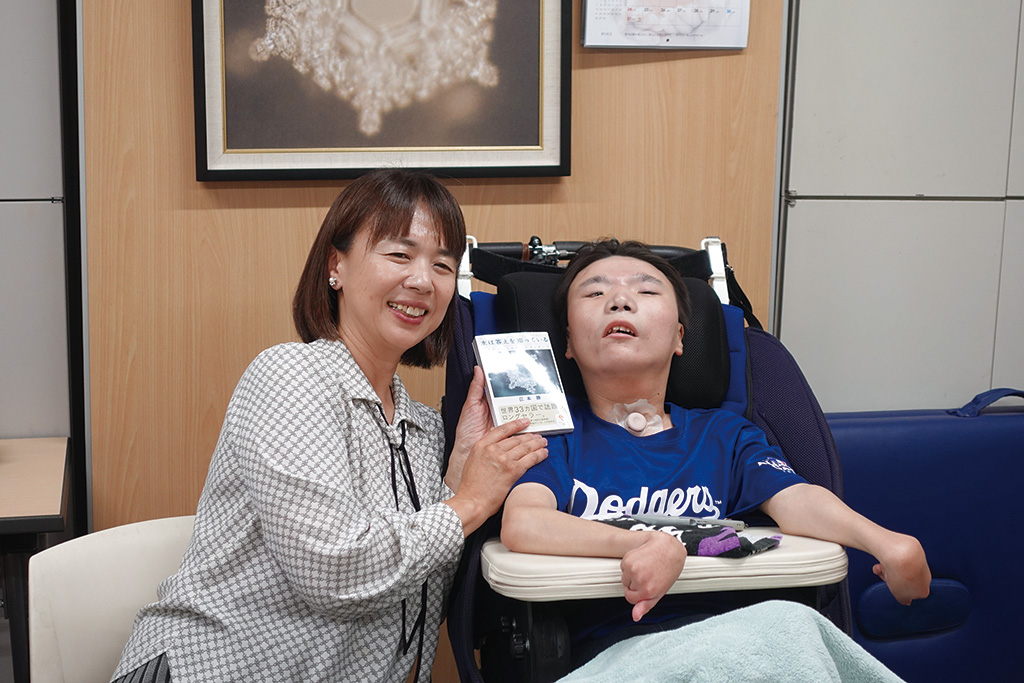
Takeno Kajimoto, mother, and her son, Mitsutaka
Love and Gratitude Create a Miracle in the Heart
The doctors had told me, “There is a hole in his heart, and his lungs are stiff. Nothing is functioning normally. Eventually, they will stop working.” The reality was that because there were no documented cases of individuals with Trisomy 13 growing up, no treatments could be offered. But the one thing I could do was resolve to transform the water in my son’s body into beautiful crystals of love and gratitude.
In his blood tests, there was a marker used to measure heart failure (NT-proBNP). While a healthy person’s level is under 18, my son’s initial level was a staggering 1,000. However, at one point, it dropped to around 700. When I asked the doctor why it had gone down, he replied, “It just happened to drop, but it will get worse again. I wouldn’t hold out hope…”
I simply said, “I see.” But when we checked it the following month, it had dropped even further.
I realized that the drop in heart failure numbers meant his body was responding with joy. At the same time, I made sure to hold and touch him in ways that felt comforting and reassuring. I kept reading Dr. Emoto’s book out loud, communicating my thoughts to my son.
By allowing myself to feel love and gratitude, those emotions reached him. I continuously visualized his blood turning into beautiful crystals. Over time, his heart failure markers stabilized.
Today, they sit around 30, and at his absolute best, they reach 18—almost completely normal for a healthy person, whose levels are usually in the single digits.
The doctor eventually told me, “His levels have dropped to normal.” It took a very long time to get there, but the numbers steadily and surely went down. When they suddenly dropped to around 700 early on, I knew for certain we were on the right track. At the same time, physical contact proved to be incredibly important. I didn’t just touch him lightly; I touched him firmly and securely. Since his heart metrics improved so rapidly, I decided to focus on his lungs next.
Shifting Focus to the Lungs and Breathing Independently
My son suffered from pulmonary hypertension. The doctors explained that because of the hole in his heart valve, excessive pressure was being placed on his lungs, causing them to stiffen, give out, and eventually stop working. They told me there was no cure, and at best, we could only maintain his current state. So, then I began thanking his lungs too.
I spoke to his lungs repeatedly, as if broadcasting over a PA system. Even though the first doctor insisted his pulmonary hypertension would cause his lungs to stiffen and that a recovery was absolutely impossible, when we transferred to a new hospital, the new doctor told me clearly: “Your child does not have pulmonary hypertension.”
Hearing that he was okay, I felt the time had come to remove the ventilator. I had been communicating with my son’s body every single day just for this moment. One day, the ventilator screen flashed a signal indicating “spontaneous breathing.”
If this signal increased, it was proof he was breathing on his own. As I watched closely, the frequency began to rise. Since his natural breathing started conflicting with the ventilator, we began “independent training”—unplugging it for 10 seconds, then 20 seconds, then a minute, gradually increasing the time. I monitored his oxygen levels constantly using a pulse oximeter on his fingertip. The time grew from one or two minutes to ten minutes, and he steadily became able to breathe entirely on his own.
When I mentioned to the doctor, “His breathing is clashing with the machine, so I think he dislikes the ventilator now,” He told me: “That is absolutely impossible, and no one has ever successfully come off it. Don’t do anything unnecessary!”
Despite the warning, I didn’t give up and secretly kept up our independent training. The time grew to 40 minutes and kept increasing. I knew he could do it. After I pleaded multiple times, the doctor finally said, “If you are that insistent, let’s admit him for a short hospital stay to verify it with a technician.”
When the doctors monitored him in the hospital, they were utterly astonished. The doctor said, “His oxygen saturation isn’t dropping, and his heart rate remains stable. You can take him off the ventilator permanently.”
He hasn’t been free of a ventilator since then. He was about six years old at the time. When he was born, removing the ventilator would immediately cause cyanosis (turning blue), requiring an oxygen tank. But by age six, he was off the ventilator, and by age seven, he no longer needed oxygen tanks either.
He used to have a cannula in his nose, but last year even that was removed, leaving him completely free. Although we still perform direct suctioning, he experiences no blockages. He no longer requires any respiratory equipment and lives fully on independent breathing.
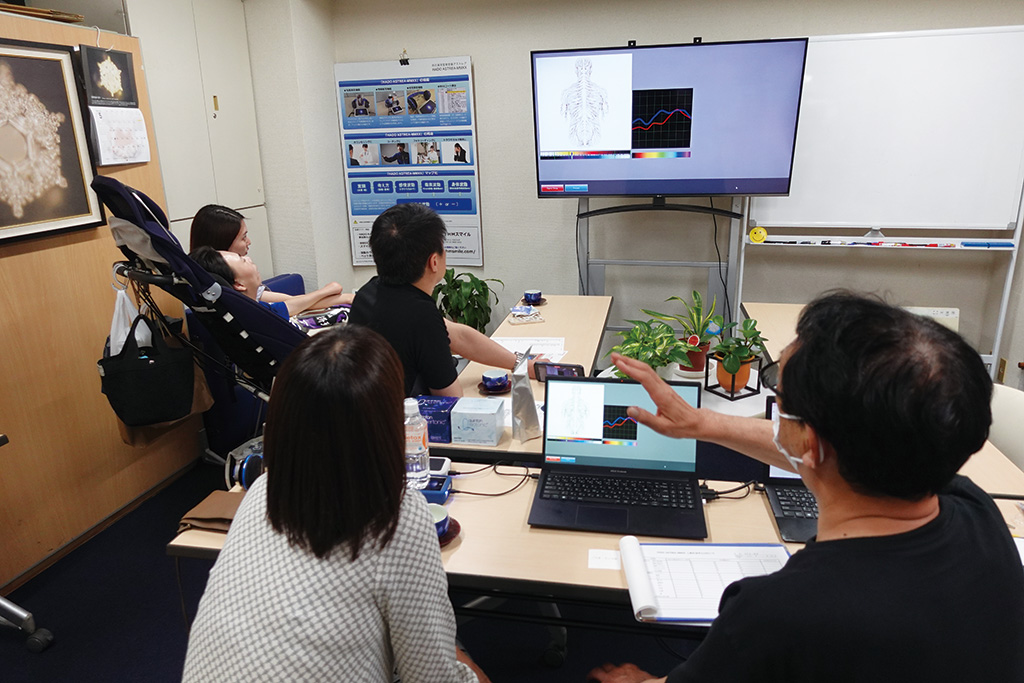
A Message from Mr. Oki (Following a HADO Astrea Reading Session): “The HADO Astrea measurement indicates that on a soul level, he may have chosen a life of self-sacrifice to bring awareness to his father, family, and relatives. He possesses a magnificent soul, born with a powerful will to bring realization to others, even at great personal cost.”
Gaining Cntrol Over Digestion and Body Temperature
In the beginning, he couldn’t pass stool or gas; his intestines simply weren’t functioning. I was told it would be best to give him a colostomy bag, but I fought against it and kept refusing the doctors until the very last moment. Today, he can do it all on his own.
He also couldn’t regulate his body temperature. In the winter, it would drop below 34°C (93.2°F), and in the summer, it would spike to 38°C (100.4°F). His average temperature used to be quite high, but now he regulates it beautifully, maintaining a normal baseline of 36.5°C (97.7°F) regardless of the outside weather.
Furthermore, his stomach and intestines weren’t working initially, and he was diagnosed with Hirschsprung’s disease, which causes intestinal tissue to die. Today, that condition is gone. He doesn’t use a feeding tube (gastrostomy) and has progressed to eating one meal a day entirely by mouth.
At first, his mouth, lips, and tongue couldn’t move at all, but now he can chew and swallow, and his gastrointestinal tract digests the food. Everything he eats and drinks becomes one with him, nourishing his body. He has truly shown us his innate power to live.
Living Beyond Precedents
Doctors have told me, “There are no past records of children with Trisomy 13 living this long, and we have never met anyone older than your son. He is the oldest.” Thinking there might be more hope in the United States with its advanced medicine, I inquired, but found out that there are no recorded living children with Trisomy 13 in Hawaii or mainland America either.
When I asked why, I was told that because there are no precedents and it is understood they cannot survive, treatment is generally not pursued from the start.
Instead, they asked in surprise, “Are there actually children with Trisomy 13 alive?” When we replied, “There is a 17-year-old in Japan,” they expressed a strong desire to visit Japan to see him. Through these exchanges, my hope and expectations for a life once thought lost grew immensely.
Attending School and Eating School Lunches
I heard that Dr. Emoto first spoke about water and HADO vibrations in Switzerland. It took time for his work to be recognized in Japan, though it was deeply understood abroad. When I realized, “My son is alive today thanks to Dr. Emoto—how can I convey this?” I found that the more gratitude I felt toward my son for being born, the healthier he became. The power of gratitude is truly extraordinary!
He is now a third-year high school student. He has perfect attendance and never misses a day. He goes to school regularly and participates in classes. Because it is a special education school, many children have severe conditions, and many are unable to attend physically. Initially, because of his ventilator, my son couldn’t attend school either; a visiting teacher would come to our house. But once the ventilator came off, he was able to go, starting from the fourth grade of elementary school. Now, staying from morning until after school, and eating his school lunch regularly, has become his normal daily routine.
Creating a Haven for Parents and Children in Similar Situations
At first, I was completely isolated. The doctors told me there was no hope and that I should just take him home to pass away. But I believed in the potential of my son’s life and his will to live. I filled our home with music, spoke kind words, conveyed positive thoughts, and never let up on physical skin-to-skin contact.
While living this way, I learned that many mothers raising children with severe disabilities suffer from depression, and divorce rates are high. I thought, “If there were a place where these mothers could gather and talk, and if I could share what my son and I experienced, it might give everyone strength.” When a mother is cut off from society, isolated, and living in despair, the child suffers, and the mother does too. When pushed to the brink, thoughts of despair can arise, so I want to tell them: It’s going to be all right.
Believing that a mother can find happiness by working alongside her child, I decided to open an after-school day service. Three years ago, I opened Waku Waku Home in Tenri City, Nara Prefecture—a place for children requiring intensive medical care.
Mothers who first come to us are often depressed, lacking energy, and feeling helpless while facing incredibly difficult circumstances with their children. Yet, they gradually regain their vitality. By practicing love, gratitude, and mindful communication, and by intending a space of safety, everyone’s mindset shifts.
In my case, a mother who once knew total despair stood up, found her strength, and subsequently, her child grew healthier and stopped requiring hospitalizations.
When we cooperate so that mothers of severely disabled children can work as nurses or childcare providers right alongside their own children in society, the mothers thrive, the siblings thrive, and the husbands thrive too. That positive energy spreads widely.
It’s about letting go of self-doubt and suffering, becoming lighter, holding hands, and lifting each other up. Parents leave Waku Waku Home with smiles, saying, “That was so much fun! Thank you!”
We also host overnight stays at the home. When I share this story during those times, everyone is deeply moved, and they go on to express gratitude to their other children as well. This is why I want to share Dr. Emoto’s teachings with as many people as possible, and I speak about it in various places. I show them the children’s version of The Message from Water, explaining that saying “thank you” creates beautiful, sparkling crystals, while harsh words break them. When taught this, the siblings begin using kinder language, hugging one another, and saying, “You’re so cute, thank you, I love you.”
Through sharing this story, I have met and connected with countless people. I used to feel a sense of loneliness because Dr. Emoto has passed away and I could never meet him in person. Visiting his company today and seeing everyone carrying on his legacy and vision makes me incredibly happy.
Giving Love and Gratitude to Everything
A few years ago, there was a stage production in Tokyo themed around “Living,” and my son and I were invited to perform. I shared the story I am telling you now, along with our work at the day service, and we were awarded the Grand Prix.
The following year, we were invited to speak at the Osaka Jou Hall for an online circus event aimed at distributing free circus tickets to children with disabilities and illnesses in hospitals. I spoke there using PowerPoint slides showing the water crystals.
Every time I share this story, I feel our connections expanding. For instance, if a child is fighting pediatric cancer, I suggest expressing gratitude to their cancer medication—imagining it transforming into a beautiful crystal as it enters the body. Remarkably, a child with pediatric cancer truly recovered and is doing wonderfully well today. If we extend love and gratitude to chemotherapy, and to everything we eat and drink, wouldn’t any substance transform into positive energy?
The concept of “love and gratitude” is a gift I learned from Dr. Emoto’s books. Encountering his book saved both my son and me. Thank you from the bottom of my heart.
To anyone carrying burdens in their body or mind: why not try expressing love and gratitude to every corner of your own body? Loving and cherishing yourself is exactly what the water crystal photographs in Dr. Emoto’s books are trying to tell us—they show us that our inner water responds by forming beautiful crystals.
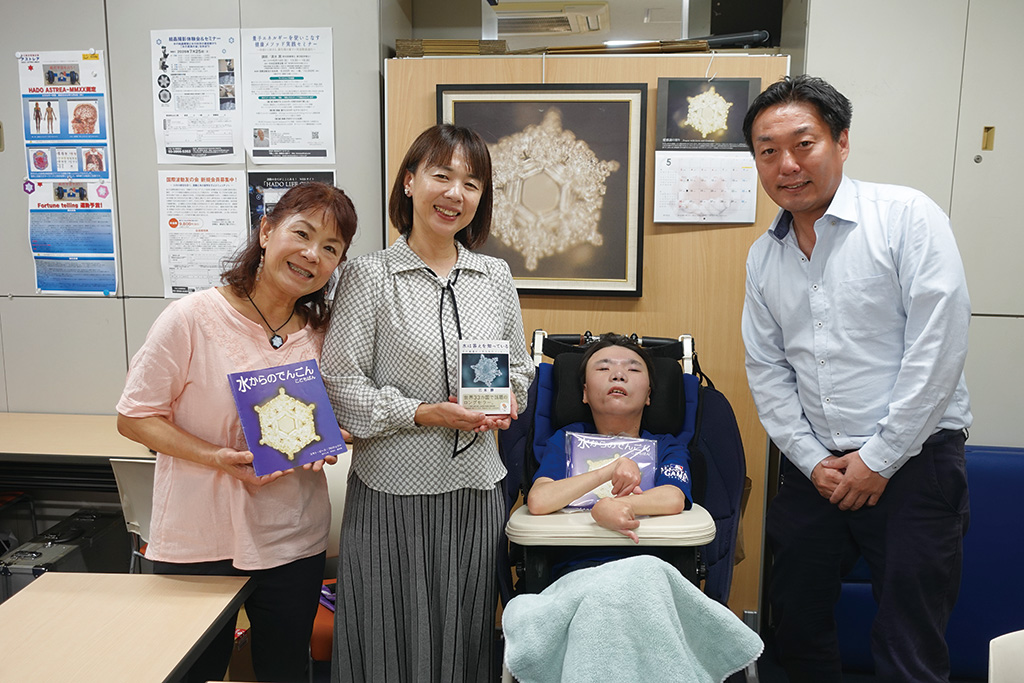
Profiles
- Mother: Takeno Kajimoto
Representative of “Waku Waku Home,” a child development support and after-school day service for children with severe motor and intellectual disabilities in Tenri City, Nara Prefecture.